You’re likely managing multiple cloud platforms, but with that comes a significant challenge: how do you make sure it all works seamlessly?
Precedence Research predicts the multi-cloud management market will explode, growing from USD 16.02 billion in 2025 to USD 147 billion by 2034, with an annual growth rate of 27.94%.As more organizations adopt multi-cloud strategies, the complexity of managing various services, platforms, and costs is becoming a real headache.
McKinsey found that even though 65% of companies have over 20% of their workloads in the cloud, many still struggle to fully optimize their cloud environments. This results in millions lost to underutilized resources, misconfigurations, and firefighting.
As an engineering leader, you're not just dealing with technical issues, but you’re also balancing cost, performance, and strategy. This is why we’ve put together this guide to outline what multi-cloud management really takes, and explain how modern tools, especially autonomous platforms, are helping businesses better manage their cloud ecosystems.
What Is Multi-Cloud Management?
Most enterprises today are multi-cloud by accident, not by design. Acquisitions, regional regulations, shadow IT, and team preferences often leave organizations juggling AWS, Azure, GCP, Kubernetes clusters, and SaaS services simultaneously.
Each of these environments has its own APIs, billing formats, compliance requirements, and security models, which makes centralized management a formidable challenge.
Take, for example, the task of updating security settings across AWS, Azure, and GCP. Each platform requires different steps, interfaces, and processes, creating significant friction. Managing these environments separately leads to increased complexity, misconfigurations, and inefficiencies.
Multi-cloud management addresses this challenge by offering a streamlined approach to coordinate and control all environments from a single location, creating a unified operational model for engineering, finance, and security teams.
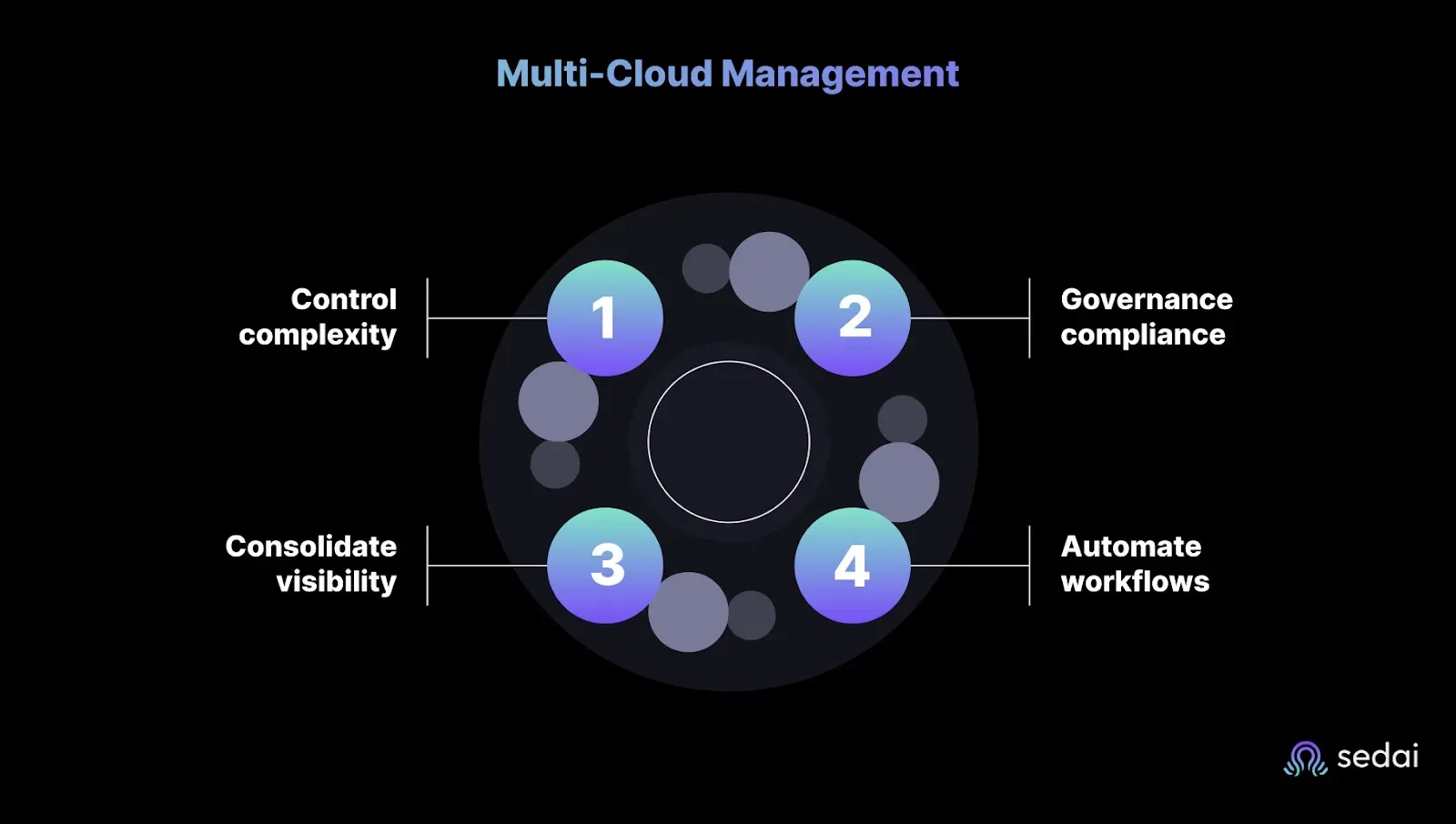
Multi-cloud management is the discipline, and increasingly, the tooling that allows engineering leaders to:
- Control complexity across heterogeneous environments.
- Standardize governance and compliance when every provider has different policies.
- Consolidate visibility into usage, costs, and performance across providers.
- Automate workflows that would otherwise require large DevOps teams.
The catch is that most tools only go halfway: they surface the problems, but leave humans to make sense of them and take action. And humans, especially in high-scale cloud environments, are already running on fumes.
Multi-Cloud vs Hybrid Cloud: What's the Difference?
It’s important to understand the distinction between multi-cloud and hybrid cloud, because managing them requires different approaches.
Who needs multi-cloud management?
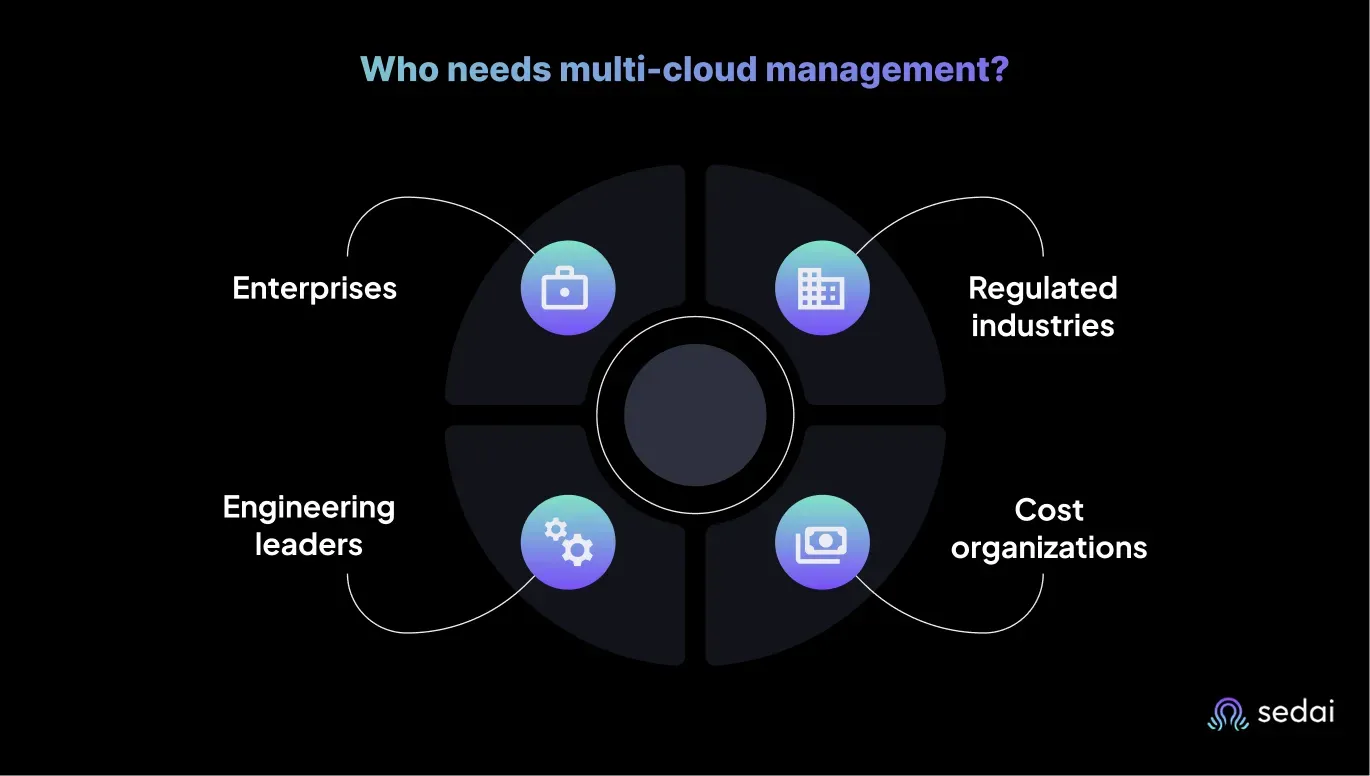
- Enterprises running multiple business units, each adopting different cloud providers.
- Regulated industries (finance, healthcare, government) that require redundancy, compliance, and auditability across multiple environments.
- Engineering leaders who want to free their teams from repetitive tasks and tool sprawl, and instead focus on building and shipping products.
- Cost-sensitive organizations that are looking to avoid vendor lock-in and take advantage of competitive pricing between providers.
Benefits of a Multi-Cloud Strategy
By the end of 2026, Forrester expects fewer than 60% of cloud customers to rely solely on hyperscaler-native security, with 40% adopting specialist platforms instead. That shift highlights a broader reality: enterprises need flexibility and resilience that no single provider can deliver on its own.
A multi-cloud strategy can deliver:
- Avoid lock-in: Pricing leverage and freedom to use best-fit services.
- Stronger security posture: Multi-cloud strategies enable distributed compliance frameworks and Zero Trust architectures.
- Unified observability: Consistent monitoring across apps, infra, and user experience, critical when each cloud’s telemetry differs.
- Faster troubleshooting: Consolidated performance and usage data makes root cause analysis faster than jumping across dashboards.
- Disaster recovery readiness: Multi-cloud replication improves continuity planning when a single provider has an outage.
- Developer portability: With containers and Kubernetes, teams can run the same workloads across providers with less friction.
A multi-cloud strategy reduces the friction inherent in managing disparate cloud environments. But the real value comes when tools can autonomously take the necessary actions to optimize these environments, reducing overhead and ensuring efficiency across the board.
Fragmented dashboards and billing chaos across AWS, Azure, and GCP compound fast. Book a demo to see how Sedai gives you a unified optimization layer across all three.
Challenges of Implementing a Multi-Cloud Strategy
Solving vendor lock-in with multiple providers comes at a cost of its own. Without a plan, many enterprises end up with spiraling bills, fragmented governance, and more operational drag than they started with.
The main hurdles we’ve seen include:
- Increased complexity: Every provider has its own APIs, SLAs, and service models. Managing them in silos quickly becomes unsustainable.
- Governance and Security: KPMG's 2024 report points out that multi-cloud introduces new challenges around accountability, cost trade-offs, and consistent security enforcement.
- Tool fatigue: Teams juggle multiple consoles, monitoring systems, and billing dashboards. The result is overlapping subscriptions and rising operational overhead.
- Billing chaos: AWS, Azure, and GCP all use different pricing models and billing cycles. Without a consolidated view, finance teams struggle to allocate spend or forecast accurately.
- Inconsistent tagging and metadata: A cost allocation system that works in AWS may not apply cleanly in Azure or GCP. This makes it harder to track usage, assign ownership, or enforce standards.
- Lack of unified accountability: With workloads spread across clouds and teams, no one has a clear picture of ownership. That leads to misconfigurations, unmanaged costs, and delayed incident response.
- Security gaps: Multi-cloud expands the attack surface. If policies aren’t applied consistently across providers, vulnerabilities multiply and compliance audits become painful.
These challenges explain why enterprises are increasingly turning to multi-cloud management platforms not just for visibility, but for automation, cost control, and governance at scale.
A multi-cloud management platform is software that gives enterprises a single way to operate across multiple cloud providers. Instead of logging into AWS for one workload, Azure for another, and Google Cloud for analytics, these platforms create a unified control layer.
How Do They Work?
These platforms connect to each provider’s APIs, pulling in data on usage, spend, and performance. They normalize inconsistencies in tagging, billing cycles, and telemetry, making the sprawl easier to interpret.
Aggregation and normalization of data are necessary, but they aren't enough to manage a cloud environment effectively. As things evolve in real-time, you can’t afford to wait for someone to manually interpret a report and take action. Platforms need to be able to not only aggregate but also act on that data, scaling resources, rightsizing, or optimizing costs as conditions change.
Just because you can see a problem doesn’t mean you’re set up to solve it. The key to truly managing a multi-cloud environment lies in automation, and that's where most tools fall short.
Forrester's 2024 Automation Survey reveals that organizations are increasingly adopting automation tools to manage multi-cloud environments, aiming to reduce manual interventions and improve efficiency.
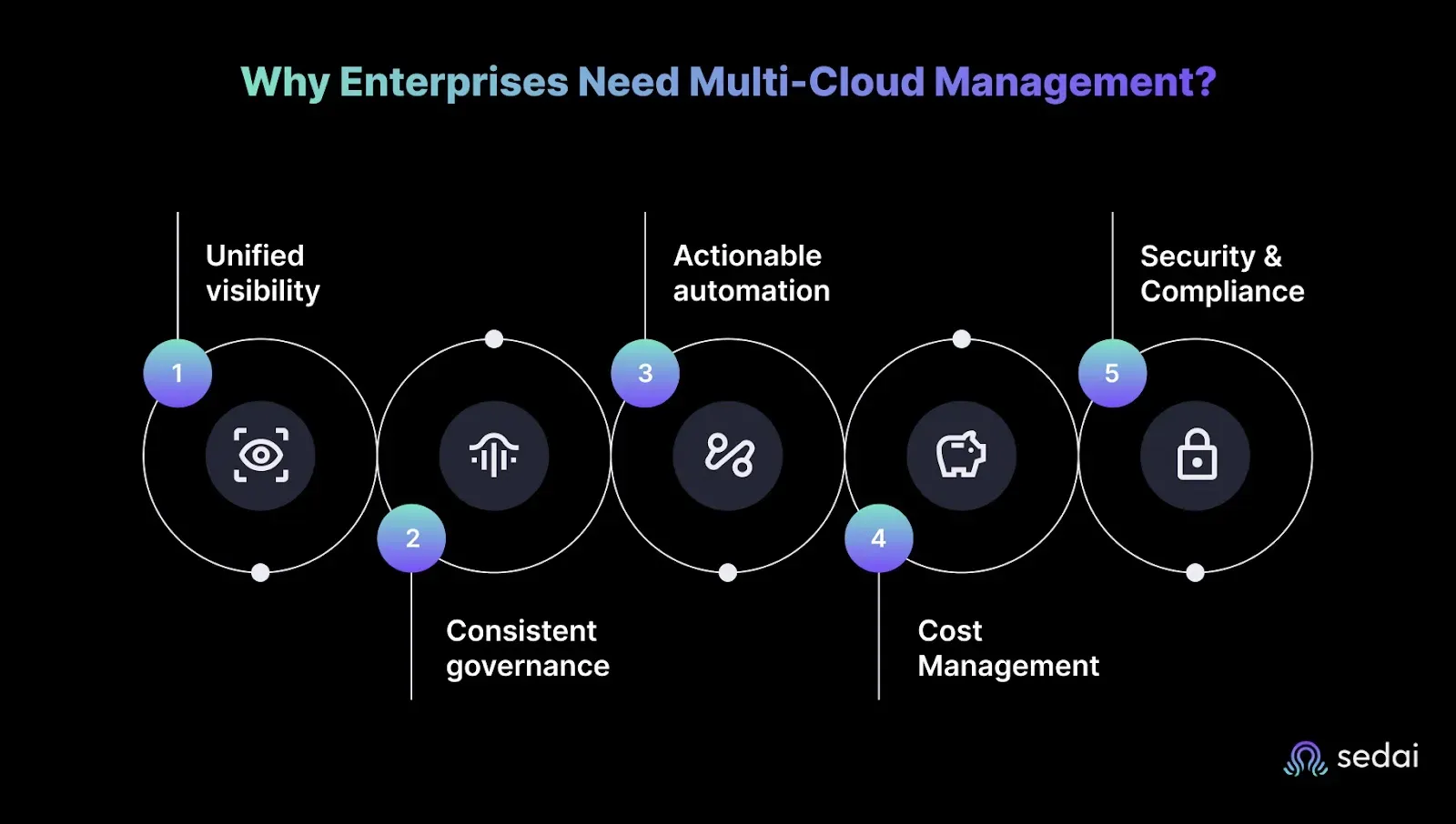
Multi-cloud management platforms offer:
- Unified visibility: One interface instead of juggling dozens of dashboards.
- Consistent governance: Policies, access controls, and compliance applied across providers.
- Actionable automation: Not just reporting, but the ability to take corrective action on cost, performance, and security.
- Cost Management: BCG's 2025 report emphasizes that without continuous monitoring and optimization, cloud costs can spiral out of control, highlighting the need for effective multi-cloud management platforms.
- Security and Compliance: Nearly 44% of organizations have experienced a cloud data breach, with 14% reporting significant incidents. Multi-cloud management platforms help mitigate these risks by offering standardized controls and audits across multiple providers.
For CIOs and engineering leaders, the question is no longer whether to adopt a multi-cloud management platform—it’s which one.
In 2024, 89% of organizations adopted multi-cloud strategies, and 68% of organizations are planning to increase cloud spend (Gartner). With the rise in cloud spending, an autonomous platform will be critical in adapting resources to real-time changes and keeping your operations running efficiently.
Here are the top platforms to watch in 2026, starting with the one designed to handle the chaos autonomously.
1. Sedai: Autonomous Multi-Cloud Management
Managing multi-cloud is complex: hundreds of services, dozens of apps, and endless billing cycles across providers. Traditional tools give dashboards and alerts, but humans can’t keep up with the scale or speed of change.
Sedai takes a different path. Instead of waiting for engineers to react, it acts autonomously:
- Learns how your services and applications behave over time.
- Understands the ripple effect of changes across distributed systems.
- Acts proactively to cut costs and resolve issues automatically.
This real-time intelligence is what sets Sedai apart. Where most platforms show you what’s wrong, Sedai actually fixes it, adjusting commitments, rightsizing resources, and tuning workloads without manual input.
For enterprises, this means:
- Lower costs (often 30–50% savings).
- Fewer escalations to engineering teams.
- Resources that adapt to demand in real time.
Best for: Enterprises managing large-scale, multi-cloud environments that need real-time optimization without constant manual adjustments.
Why Sedai Stands Out
- Safety and Reliability: Sedai’s autonomous actions are governed by learned behavior profiles and safety checks to avoid disruption. By understanding normal system behavior first, Sedai gradually introduces changes with built-in safeguards to minimize risk, ensuring performance optimizations without compromising stability.
- Autonomous Operations: 100,000+ production changes executed safely; up to 75% lower latency with no manual input.
- Proactive Uptime Automation: Detects anomalies early, cutting failed customer interactions by 50% and improving performance up to 6x.
- Smarter Cost Management: 30–50% cost savings through rightsizing and tuning. Palo Alto Networks, for example, saved $3.5M by letting Sedai manage thousands of safe changes.
Unlike most platforms that stop at visibility or orchestration, Sedai self-driving cloud closes the loop, operating as a self-optimizing layer that keeps your cloud efficient, secure, and cost-effective.
2. IBM Multi-Cloud Manager
IBM’s stack pairs Turbonomic for automated performance/cost optimization with Cloudability (Apptio) for FinOps reporting and allocation. Turbonomic can automate actions like pausing idle workloads and rightsizing to improve spend and performance. IBM acquired Apptio in 2023, bringing Cloudability’s cost allocation and reservation coverage into the portfolio.
- Strengths: Rich governance features, deep container management, enterprise-scale integrations.
- Best for: Highly regulated industries (finance, healthcare, government) with large-scale Kubernetes and hybrid deployments.
3. Nutanix Cloud Manager (Beam)
NCM Cost Governance (formerly Beam) gives unified visibility and chargeback across Nutanix on-prem plus AWS, Azure, and GCP, with policy-driven optimization and rightsizing. Unlike many cloud-native tools, NCM gives IT leaders a way to unify on-prem and public cloud governance. It combines automation, cost visibility, and policy enforcement into a single layer.
- Strengths: Hybrid + multi-cloud management, cost governance, strong automation workflows.
- Best for: Enterprises still balancing on-prem infrastructure with AWS, Azure, or GCP, looking to standardize governance across both worlds.
4. VMware (CloudHealth, Tanzu, Aria Cost, Foundation Automation)
VMware brings one of the most comprehensive portfolios in the space. CloudHealth is widely adopted for FinOps and cost visibility. Tanzu modernizes applications with Kubernetes. Aria Cost and Cloud Foundation Automation extend VMware’s control to hybrid and multi-cloud setups.
- Strengths: Deep visibility, policy-driven governance, strong Kubernetes integration with Tanzu.
- Best for: Enterprises already standardized on VMware or those undergoing application modernization at scale.
5. Red Hat OpenShift
OpenShift has become the enterprise standard for Kubernetes orchestration. It provides developer tools, CI/CD pipelines, and governance capabilities to manage containerized apps across AWS, Azure, GCP, and on-prem environments.
- Strengths: Enterprise-ready Kubernetes distribution, strong compliance, operator ecosystem for scaling apps.
- Best for: Enterprises with DevOps maturity and regulated workloads that need consistency across hybrid and multi-cloud deployments.
6. Red Hat Ansible
While OpenShift focuses on Kubernetes, Ansible brings powerful infrastructure automation across hybrid and multi-cloud setups. Engineering teams use it for repetitive tasks, configuration consistency, and infrastructure orchestration.
- Strengths: Open-source flexibility, strong automation at scale, well-adopted in enterprise IT.
- Best for: Enterprises that need repeatable, code-driven automation across AWS, Azure, GCP, and on-prem environments.
7. Morpheus
Morpheus provides a single platform for managing hybrid, multi-cloud, and on-prem environments. It helps enterprises with cloud resource provisioning, orchestration, and governance. Morpheus integrates with platforms like VMware, OpenStack, Azure, AWS, and more, ensuring a consistent operational experience across clouds.
- Strengths: Self-service provisioning, cloud cost optimization, API integrations, and centralized governance.
- Best for: Enterprises that need to manage multi-cloud infrastructure with strong governance, cost management, and automation.
8. CloudBolt
CloudBolt is designed to provide visibility and governance across hybrid cloud environments, including multi-cloud architectures. It focuses on cost visibility, budgeting, forecasting, and resource allocation across AWS, Azure, and GCP. With its self-service provisioning capabilities, it allows IT teams to maintain control while giving developers flexibility.
- Strengths: Cloud cost tracking, resource provisioning and optimization, and strong integrations with ITSM tools.
- Best for: Enterprises that need detailed cost analysis and governance across hybrid and multi-cloud environments.
9. Terraform by HashiCorp
Terraform is a widely used Infrastructure as Code (IaC) tool that enables teams to provision, manage, and scale cloud resources across multiple cloud providers. Its declarative configuration language allows users to define cloud infrastructure in code, making it ideal for managing environments that span AWS, Azure, GCP, and others.
- Strengths: Strong automation, multi-cloud provisioning, a large provider ecosystem, and infrastructure as code for developers.
- Best for: DevOps and platform engineering teams that need automation and scalability across multiple cloud platforms.
10. CloudZero
CloudZero focuses on providing real-time cloud cost visibility tailored to engineering teams. By breaking down cloud spending at the product, team, and feature level, CloudZero enables teams to align cloud costs with business goals. It automates cost allocation, budgeting, and anomaly detection, making it ideal for companies that want actionable insights into their cloud spend.
- Strengths: Detailed cost allocation, forecasting, anomaly detection, and integration with AWS, Azure, and GCP.
- Best for: Engineering and FinOps teams looking for an intuitive platform to optimize cloud costs and align spending with business outcomes.
When we talk with SRE and DevOps teams, one theme comes up again and again: the time lost to wrestling with cloud complexity. Too many hours go into stitching together visibility, policing costs, and trying to make sure security rules apply equally across AWS, Azure, GCP, and Kubernetes.
The right platform should make this mess easier to manage without adding more overhead.
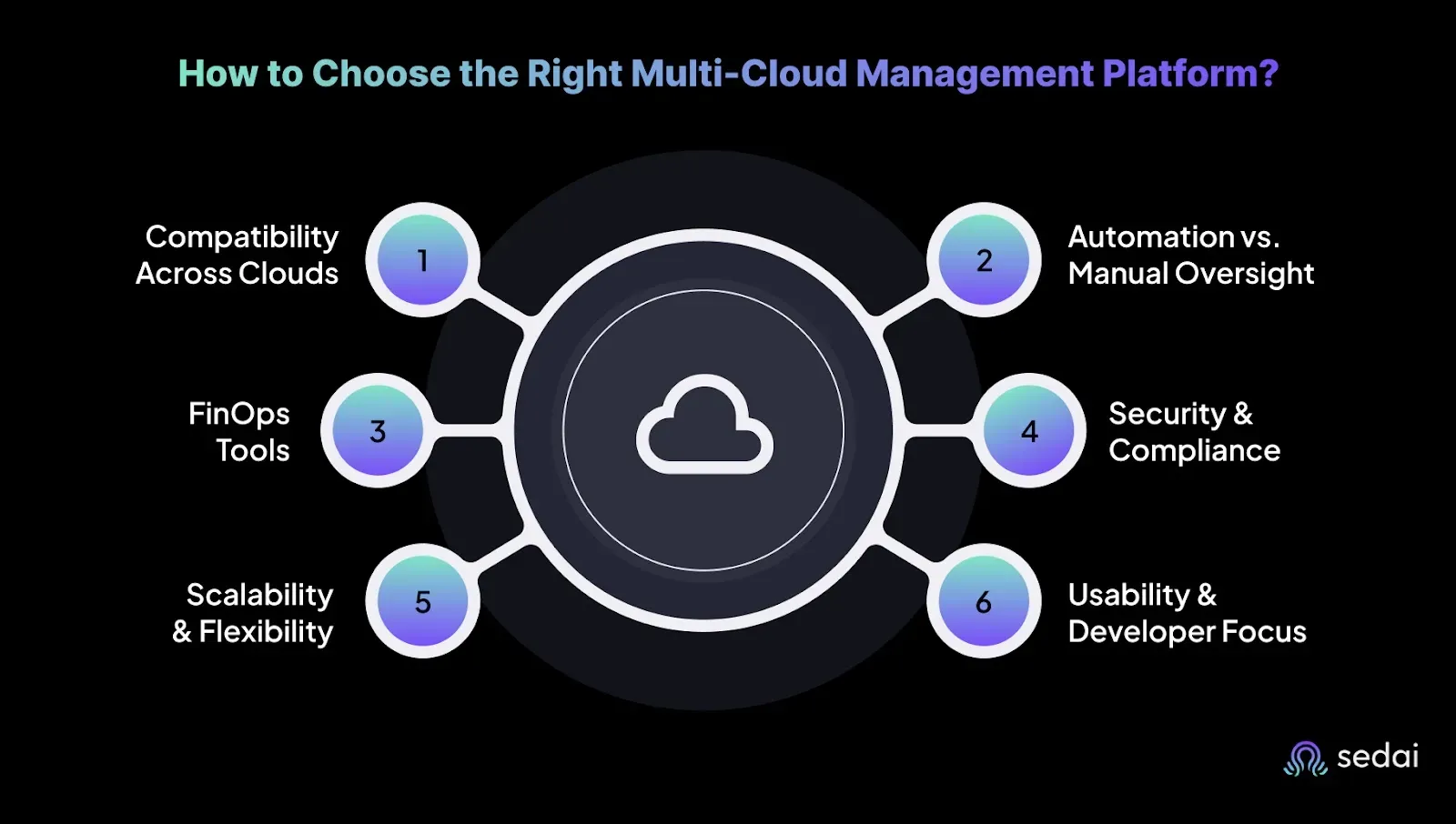
1. Compatibility Across Clouds
Your platform should run cleanly across AWS, Azure, GCP, and Kubernetes. We’ve seen how frustrating it is when one provider becomes the center of gravity and everything else requires workarounds. True compatibility avoids lock-in and centralizes management without breaking existing setups.
2. Automation vs. Manual Oversight
Dashboards alone don’t scale. If the platform stops at surfacing metrics and requires manual intervention to act, it simply shifts the burden to already stretched engineering teams.
What we’ve found most useful are platforms that automate actions in real time, adjusting resources when demand changes or shutting down underutilized capacity without waiting for human intervention.
Sedai, for example, has taken this direction by focusing on autonomous optimization rather than just surfacing alerts. That kind of automation is what allows teams to spend less time firefighting and more time improving reliability.
3. Financial Operations (FinOps) Tools
We’ve seen finance and engineering teams burn days reconciling cost reports that arrive weeks after the fact. A solid MCMP should give you real-time cost tracking, forecasting, and anomaly detection so you can address spend patterns before they snowball.
4. Security & Compliance
Your MCMP must include strong IAM, data encryption, and ensure compliance with relevant standards (SOC 2, HIPAA, etc.). It’s critical to enforce policies consistently across clouds without creating security gaps.
5. Scalability and Flexibility
As your cloud needs grow, the MCMP should scale without reconfiguration. The platform must be able to handle increasing workloads and adapt to new cloud providers, regions, and services.
6. Usability and Developer Focus
Tools need to be intuitive and integrated into your existing workflows. Choose a platform that offers clear dashboards for visibility, CI/CD integration, and developer tools like CLI and APIs. An overly complex tool can create more problems than it solves, so focus on ease of use.
The right MCMP should make multi-cloud simpler, cheaper, and more secure. Sedai does this with autonomous optimization, removing the manual guesswork from cloud management.
Multi-cloud visibility is only useful when it leads to action. Book a demo to see how Sedai moves from insight to autonomous optimization across AWS, Azure, and GCP.
Conclusion
Managing a multi-cloud environment is extremely difficult. With hundreds of individual services, dozens of applications, and countless cloud bills, the complexity can quickly spiral out of control. The only way to effectively manage this chaos is through an autonomous platform that can act without manual intervention, eliminating unnecessary costs and remediating issues in real-time.
This is where platforms like Sedai excel. By learning how your services and applications behave and responding to changes automatically, Sedai ensures your resources are always aligned with your business needs.
Join us and start automating your multi-cloud operations with Sedai’s autonomous platform.
FAQs
1. Why are enterprises adopting multi-cloud strategies?
Enterprises are adopting multi-cloud strategies to prevent vendor lock-in, improve redundancy, optimize costs, and access specialized services from different cloud providers. It also offers flexibility for handling varied workloads across different environments.
2. Is AWS a multi-cloud?
No, AWS is not a multi-cloud platform. It is a single cloud provider. Multi-cloud refers to using multiple providers (e.g., AWS, Azure, GCP) simultaneously to leverage the unique strengths of each.
3. Is a hybrid cloud a multi-cloud?
While both hybrid and multi-cloud involve multiple cloud environments, hybrid cloud specifically combines private and public clouds, often with seamless data and workload integration between the two. Multi-cloud, on the other hand, involves using multiple public cloud providers.
4. What challenges come with managing a multi-cloud environment?
Managing multi-cloud environments introduces challenges like complexity in integration, inconsistent service offerings across clouds, managing data security and compliance, monitoring performance across multiple platforms, and ensuring cost optimization.


